

Global Broker Regulation Inquiry App
About WikiFX
English
简体中文
繁體中文
English
Pусский
日本語
ภาษาไทย
Tiếng Việt
Bahasa Indonesia
Español
हिन्दी
Filippiiniläinen
Français
Deutsch
Português
Türkçe
한국어
العربية
Broker Minimums, Leverage Choices, and Avoiding Forced Position Closures
Abstract:A practical breakdown of the fundamental account mechanics that often catch beginners off guard, covering broker deposit limits, lot sizes, margin limits, and how to prevent forced liquidations.
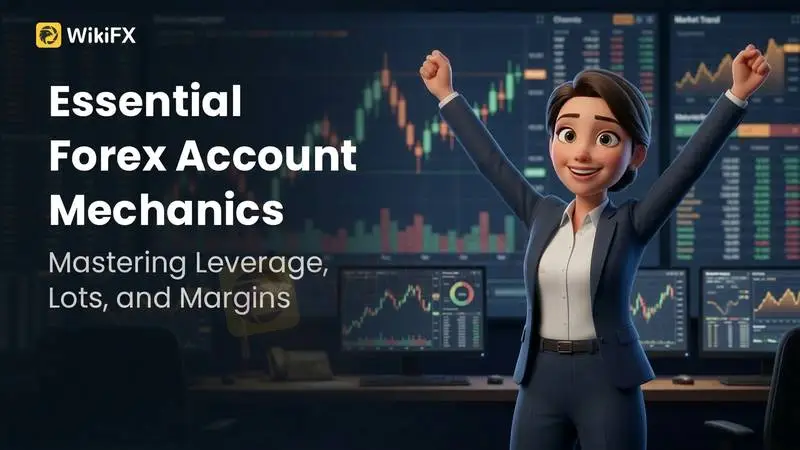
Broker Minimums, Leverage Choices, and Avoiding Forced Position Closures
Many new traders step into the forex market thinking primarily about which currency pair to trade or when to buy and sell. However, the most common reasons beginners lose their capital early on have nothing to do with market direction. They relate to the structural mechanics of a trading account: misjudging lot sizes, pushing leverage too far, and getting caught in forced liquidations.
Instead of guessing how the system works, here is a practical look at the core account mechanics you need to manage before you place your first trade.
The Reality of Broker Entry Thresholds
A frequent question from beginners is whether there are high barriers to entering the forex market. Generally, opening a trading account is simple, but making your first deposit does involve minimum thresholds set by the broker.
Depending on the trading platform and the funding method you choose, minimum deposits can range dramatically. Some platforms allow entry with a few dozen dollars, while others require much more. A major retail broker, for example, might require $100 if you use a wire transfer, but only $50 if you use a credit card.
However, simply meeting the lowest possible deposit requirement does not mean your account is properly funded. Starting with the bare minimum often leaves you with zero safety net to absorb normal market fluctuations once a trade is open.
Sizing Your Trades with Lots and Contracts
In the forex market, you do not simply buy “one dollar” or “one euro.” You trade standardized contracts, commonly known as lots.
A standard lot represents 100,000 units of the base currency. If you are trading EUR/USD, one standard lot means you are controlling 100,000 euros. Because beginners rarely have the capital or risk tolerance to trade standard lots, brokers offer smaller increments. A mini lot (0.1) equals 10,000 units, and a micro lot (0.01) equals 1,000 units.
Every time you execute a trade, you are committing a specific contract value. If you do not understand the underlying size of the lot you just selected, even a minor shift in the exchange rate can result in unexpected dollar losses in your account.
Choosing Between 100x and 200x Leverage
Because a standard contract controls 100,000 units of currency, brokers provide leverage to allow you to trade with less upfront capital. Leverage acts as a margin deposit requirement rather than a magical boost to your funds.
If you choose 100x leverage, you only need to lock up 1% of the total contract value as an initial deposit. For a $100,000 position, that means setting aside $1,000 of your own money. If you choose 200x leverage, that required margin drops to $500.
While higher leverage frees up more of your cash in the short term, it also amplifies your risk relative to your total account size. The larger your leverage, the larger the position you can accidentally take—which means floating losses can drain your available balance much faster than you might anticipate.
Free Margin and the Pain of Forced Liquidation
Once a trade is open, your account balance is divided into two categories: “used margin” (the deposit locked up to hold the trade) and “free margin” (the remaining cash available to absorb losses or open new trades). Free margin is constantly moving based on your floating profits or losses.
When a trade begins to move against you, your floating loss eats directly into your free margin. If your free margin drops too low, the brokers system steps in to protect itself from your losses. This triggers a margin call or a forced liquidation, commonly called a stop out. Many brokers will automatically close your positions when you lose 80% of your required margin.
The most frustrating experience for a beginner is watching a trade get force-closed, taking a permanent loss, only to see the market reverse back in the right direction hours later. Once the system closes you out, that capital is gone, and you cannot recover it even if the price eventually hits your original target. The only way to survive regular market noise is to keep your trade sizes small so your free margin remains healthy.
Managing Funds Legally and Safely
The mechanics of getting your money in and out of the market matter just as much as executing a trade. Some beginners get lured by third parties offering underground money transfers, illegal foreign exchange routing, or guaranteed high-return setups outside of official banking channels.
Participating in these shadow transfers is not only illegal but puts your entire trading capital at risk of permanent loss or confiscation. Always deposit funds directly through official banking channels linked to the regulated platform. Before you send your initial deposit, take five minutes to verify the brokers regulatory status on a platform like WikiFX. Checking their license history ensures you are depositing client money into a legally verified entity rather than an unregulated trap.

Disclaimer:
The views in this article only represent the author's personal views, and do not constitute investment advice on this platform. This platform does not guarantee the accuracy, completeness and timeliness of the information in the article, and will not be liable for any loss caused by the use of or reliance on the information in the article.
WikiFX Broker
Latest News
D Prime Review: Regulation, Licences and WikiScore Analysis
 WikiFX
Quotex Review 2026: Is this Forex Broker Legit or a Scam?
WikiFXFIBOGROUP Review 2026: Is this Forex Broker Legit or a Scam?
WikiFXItaly Blocks 12 More Unauthorized Investment Websites
WikiFXCrude Shock Drives Dollar Higher
WikiFXPhysical Crude Decouples From Futures
WikiFXHerofx Regulation & License Status: A 2026 Deep Dive into the Risks
WikiFXHormuz blockade could deepen worlds worst energy crisis — and risk a dangerous misstep
WikiFXIs The 5%ers a Safe Forex Broker? WikiFX Review
WikiFXXTB Moves Closer to One Million Poland Market Accounts
WikiFXCurrency Calculator
USD

CNY
Current Rate:0
Enter amount
USD
Redeemable Amount
CNY
Calculate 