

Global Broker Regulation Inquiry App
About WikiFX
English
简体中文
繁體中文
English
Pусский
日本語
ภาษาไทย
Tiếng Việt
Bahasa Indonesia
Español
हिन्दी
Filippiiniläinen
Français
Deutsch
Português
Türkçe
한국어
العربية
PXBT Review 2026: Is this Forex Broker Legit or a Scam?
Abstract:PXBT holds a dangerous WikiFX Score of 1.38 and operates without any valid regulation. With over 14 recent complaints alleging withdrawal blocks and advance-fee scams, this broker presents a critical risk to client funds.
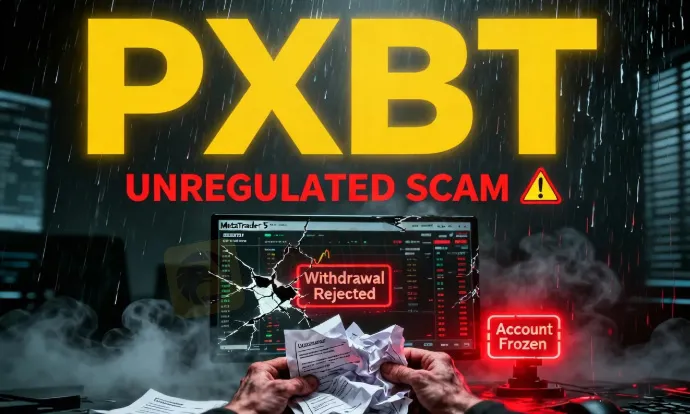
Executive Summary (TL;DR): PXBT is a high-risk, unregulated broker based in Seychelles with a critically low WikiFX Score of 1.38. Traders have reported severe issues ranging from blocked withdrawals to aggressive demands for extra payments under false pretenses.
Finding a trustworthy financial partner is stressful, especially when new brokers pop up overnight promising the world. Before you find a Forex broker to trust with your hard-earned savings, you need to look past the flashy website and analyze the cold, hard data. In this PXBT review, we analyze why this entity has generated a surge of warning signals and what its low score implies for your financial safety.
Question 1: PXBT Regulation & Safety: Is my money safe?
The Short Answer: No, your capital is likely at significant risk.
According to the WikiFX database, PXBT currently holds no valid regulation from any recognized financial institution. While they claim a headquarters in Seychelles (an offshore jurisdiction), they do not hold a license that legally compels them to protect your funds.
Why does valid regulation matter?
When you see a broker with a “No regulation” status, it means they are operating without oversight. In the world of finance, oversight is the only thing standing between you and total loss.
Educational Context: Counterparty Risk
For unregulated brokers, the biggest danger you face is called Counterparty Risk. When you deposit money with a regulated broker (like one licensed by the FCA or ASIC), your money is often kept in a “Segregated Account”—meaning the broker cannot touch it for their own expenses. However, with an unregulated entity like PXBT, your deposit goes directly into their corporate wallet. If they decide to close up shop, declare bankruptcy, or simply refuse to pay, there is no government compensation scheme to save you. You are trusting strangers with your wallet, with no legal contract to protect you.
Question 2: Are the trading fees and leverage fair?
The Analysis:
While PXBT does not transparently list its max leverage in the provided data, user reports paint a worrying picture regarding their trading costs. Several traders (Case 1 and Case 3) have reported that spreads are “terrible” and “keep widening without warning.”
The Verdict:
High or unstable spreads are a common tactic used by lower-tier brokers to erode your profits silently. One user noted that even in normal market conditions, the Forex trading costs were significantly higher than competitors, making profitable trading nearly impossible.
Educational Context: The “Double-Edged Sword” of Market Making
Unregulated brokers often act as the “Market Maker.” This means they create the market you trade in. If they are unethical, they can artificially widen the “spread” (the difference between the buy and sell price) just enough to trigger your Stop Loss order. This puts money in their pocket and takes it out of yours. When a broker controls the price feed and has no regulator watching them, the odds are often stacked against the trader.
Question 3: What are real traders complaining about?
This is the most alarming part of the data. In the last three months alone, WikiFX has received 14 complaints regarding PXBT. The severity of these cases suggests a pattern of behavior commonly associated with scam operations.
1. Withdrawal Blocks
Multiple users from the UK, Germany, and Vietnam (Cases 2, 4, 12, 14) reported that their withdrawal requests were rejected. The broker allegedly used excuses like “Do not honor” errors or simply refused to process the transaction, even when banks confirmed there were no issues on the receiver's end.
2. The “Advance Fee” Trap
A disturbing pattern has emerged in Malaysia (Cases 5, 7, 9). Support agents allegedly told traders they needed to pay more money to fix “data matching” issues, “compliance reviews,” or “synchronization” errors.
“They threatened that if I don't bind within 15 days... my principal will be frozen!” (Case 5)
Pro Tip: No legitimate broker will ever ask you to deposit more money to withdraw your existing balance. This is a classic hallmark of a scam designed to extract the last few dollars from a victim before ghosting them.
3. Trade Manipulation
One user (Case 10) reported abnormal slippage of over 2 points during news events, resulting in immediate losses, which customer service dismissed as “market volatility.”
Question 4: What software will I use?
PXBT offers the MT5 (MetaTrader 5) platform. While MT5 is the industry standard and a powerful tool for trading, its presence does not guarantee the broker is safe.
Security Warning: The PXBT Login
Just because the software is legitimate doesn't mean the person controlling the server is honest. Unethical brokers can use plugins on the back-end of MT5 to manipulate prices or introduce “virtual slippage.” Furthermore, you must be extremely cautious with your PXBT login credentials. Since the broker operates without regulation, ensure you are not downloading a modified version of the client that could compromise your device security.
Final Verdict: Should I open an account?
Absolutely not.
The combination of a 1.38 WikiFX Score, zero regulation, and specific, detailed user reports of withdrawal refusals and fee scams makes PXBT a definitive “Avoid.”
The risks here go beyond just losing a trade; the data suggests a high probability that you may not be able to withdraw your initial deposit at all. There are thousands of regulated brokers available—there is no reason to risk your capital with an entity showing this many red flags.
Call to Action: Financial status changes daily. Before depositing, check the WikiFX App for the latest real-time certificate and to find safer, regulated alternatives.
Disclaimer:
The views in this article only represent the author's personal views, and do not constitute investment advice on this platform. This platform does not guarantee the accuracy, completeness and timeliness of the information in the article, and will not be liable for any loss caused by the use of or reliance on the information in the article.
WikiFX Broker
Latest News
MTRADING Legitimacy Check: Is This a Fake Broker or a Legitimate Trading Partner?
 WikiFX
Trilt Review 2025: Is This Forex Broker Safe?
WikiFX225 People Investigated as Singapore Losses Exceed S$4.8 Million
WikiFXLuxury Villas in Sabah Raided, 28 Foreign Suspects Arrested
WikiFXWhy Smart Beginners Keep Blowing Up Their Forex Accounts
WikiFX中海寰球 Review 2026: Severe Risk Signals and Unregulated Status
WikiFXXTRADE Review 2025: Is This Forex Broker Safe?
WikiFXKAMA Capital Review: Do Traders Lose Due to Slippage & Inappropriate Liquidation?
WikiFXTradeZero Review 2026: Should You Trade With This Broker?
WikiFXCryptomaxtrade Review 2026: Unregulated Status, Low Score, and Key Warnings
WikiFXCurrency Calculator
USD

CNY
Current Rate:0
Enter amount
USD
Redeemable Amount
CNY
Calculate 