

Global Broker Regulatory Inquiry Platform
WikiFX
English
简体中文
繁體中文
English
Pусский
日本語
ภาษาไทย
Tiếng Việt
Bahasa Indonesia
Español
हिन्दी
Filippiiniläinen
Français
Deutsch
Português
Türkçe
한국어
العربية
ECB Holds Rates Steady for the Fourth Consecutive Meeting
Abstract:(Chart 1: Source: Reuters)At its latest policy meeting, the European Central Bank (ECB) decided to keep interest rates unchanged, with the deposit rate remaining at 2.00%. This marks the fourth consec

(Chart 1: Source: Reuters)
At its latest policy meeting, the European Central Bank (ECB) decided to keep interest rates unchanged, with the deposit rate remaining at 2.00%. This marks the fourth consecutive hold, fully in line with market expectations. The decision conveyed a neutral stance, neither hawkish nor dovish, with no urgency to signal either rate cuts or hikes.
Looking back, the ECB previously raised rates aggressively to contain inflation. As economic momentum cooled and inflation eased, the policy stance shifted toward rate cuts. However, once inflation approached a more acceptable range, the ECB chose to step on the brakes. The current phase can best be described as a wait-and-see mode.
The ECB‘s decision to remain on hold is not due to a lack of intent, but rather the difficulty of moving in either direction. Recent data show that core CPI in November remained around 2.4%, largely unchanged from prior readings, indicating that the pace of disinflation has clearly slowed. Headline CPI stood at approximately 2.1%, close to but still slightly above the ECB’s 2% target.
The primary concern for policymakers remains core inflation. Continued wage growth in the services sector and persistent domestic price stickiness have kept core inflation above target. The ECBs biggest fear is cutting rates too early and seeing inflation reaccelerate. As a result, policymakers prefer to wait longer to ensure that inflation is genuinely under control before taking action.
On the growth side, while the euro area economy remains weak, it has not deteriorated to the point of recession. This leaves the ECB walking a tightrope. From a growth perspective, rate cuts would be justified, but with inflation not yet fully resolved, easing policy too soon carries significant risks. Consequently, the ECB has opted to stay on hold.
In its latest projections, the ECB slightly raised its inflation forecast for next year to 1.9%, while marginally upgrading its economic growth outlook. President Christine Lagarde emphasized that the ECB will not pre-commit to any future policy timeline and will remain strictly data-dependent. Given elevated uncertainty, maintaining flexibility and allowing upcoming economic and inflation data to guide decisions remains the preferred approach.
From a FX market perspective, expectations for future rate cuts by the Federal Reserve continue to build. The outlook for U.S. interest rates has been repeatedly revised lower, keeping the U.S. dollar broadly on the defensive. With the euro relatively stable and the dollar weakening, non-USD currencies are more likely to gain upside momentum.
Summary
The ECB reiterated its data-dependent stance and avoided providing a rate-cut timetable, effectively tempering market expectations for aggressive easing. This approach provides medium-term support for the euro. A firmer euro, in turn, weighs on the DXY, while a weaker dollar and declining real yields act as key drivers for gold prices. Against a backdrop of repriced rate expectations and sustained dollar weakness, gold is likely to retain upward momentum.
Gold Technical Analysis (Multi-Timeframe)
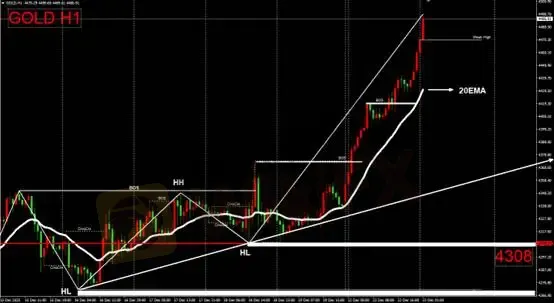
(Chart 2: Gold 1-Hour Chart)
1-Hour Chart: Eight Consecutive Bullish Candles
Gold showed minimal pullback yesterday, displaying a strong “sharp rally, shallow retracement” pattern. At one point, the market printed eight consecutive bullish candles, highlighting extreme upside momentum.
With price trading at record highs and no clear overhead resistance, the probability of further upside remains elevated. However, elevated prices also warrant caution. Profit-taking pressure could emerge at any time, and the risk of a technical correction continues to build.
Key Levels:
Discount Zone: $4,310–4,370/oz
During the Asian session, prices extended higher and have now moved significantly away from the discount zone, increasing the risk of chasing the market. Under such extreme conditions, the most prudent approach is scaled entries and position sizing, balancing risk and reward.
Hard stop-loss levels should be placed near $4,300–4,356/oz or close to recent swing lows.
Risk Disclaimer
The above views, analyses, research, prices, and other information are provided for general market commentary only and do not represent the position of this platform. All readers assume full responsibility for their own trading decisions. Please trade with caution.
Disclaimer:
The views in this article only represent the author's personal views, and do not constitute investment advice on this platform. This platform does not guarantee the accuracy, completeness and timeliness of the information in the article, and will not be liable for any loss caused by the use of or reliance on the information in the article.
WikiFX Broker
Latest News
Wholesale prices rose 0.7% in February, much more than expected and up 3.4% annually
 WikiFX
KapitalRS Exposure: Traders Report Withdrawal Issues & Trade Manipulation
WikiFXOil Prices Climb as Geopolitical Tensions Spotlight Strait of Hormuz Risks
WikiFXCapex Review: The High-Stakes Gaslighting of Retail Traders
WikiFXGold and Silver Pumping Again?
WikiFXPepperstone User Reputation: Looking at Real User Feedback and Common Complaints to Check Trust
WikiFXMazi Finance Review: Warning Signs and Customer Problems Revealed
WikiFXMalaysia’s Biggest Money Game Disasters: How Three Scams Wiped Out Billions of Ringgit
WikiFXIs MT.COOK a Safe Bet for Your Forex Trading? A Deep Dive into MT.COOK Review and Regulation
WikiFXIs M4Markets Safe or Scam? Examining Real User Experiences, Reputation & Common Issues
WikiFXCurrency Calculator
USD

CNY
Current Rate:0
Amount
USD
Available
CNY
Calculate 