Retiree loses over RM337,000 in Facebook investment scam
Authorities warn public to verify financial transactions as pensioner duped by fake online investment
Original

简体中文
繁體中文
English
Pусский
日本語
ภาษาไทย
Tiếng Việt
Bahasa Indonesia
Español
हिन्दी
Filippiiniläinen
Français
Deutsch
Português
Türkçe
한국어
العربية

Abstract:Authorities in Thailand have apprehended a Malaysian man and his Thai wife for their alleged involvement in a series of fraudulent investment schemes that inflicted financial damage amounting to 800 million baht.

Authorities in Thailand have apprehended a Malaysian man and his Thai wife for their alleged involvement in a series of fraudulent investment schemes that inflicted financial damage amounting to 800 million baht. The arrests mark a significant step in dismantling a sophisticated scam network operating across Southeast Asia.
The Central Investigation Bureau (CIB) confirmed the detention of 38-year-old Lim Chin and his wife, Saowalak, as they attempted to cross the border from Malaysia into Songkhlas Sadao district. The arrest occurred at a border checkpoint along Kanchanawanit Road following an investigation triggered by multiple complaints from victims.

The fraudulent schemes were reportedly promoted via Facebook, featuring images of prominent securities experts to establish credibility. Victims were encouraged to invest using fake mobile applications named “Nicshare” and “ComonApps.” Initially, participants received returns, which built trust and attracted further investment. However, payments eventually stopped, leaving investors with substantial losses.
According to the CIB, over 50 individuals have come forward as victims, collectively losing around 800 million baht to the scams. Investigators revealed that the criminal network, comprising both Thai and foreign members, managed financial transactions totalling approximately 5 billion baht.
Authorities described the Malaysian suspect as a leading figure within the operation. He, along with his wife, played a pivotal role in establishing companies used to create mule bank accounts. These accounts were then sold to criminal organisations across Southeast Asia. The accounts facilitated a variety of illicit activities, including call centre scams and online gambling.
The investigation has led to the issuance of arrest warrants for approximately 50 individuals believed to be part of this extensive scam network. Over the past months, the CIB has intensified efforts to track down these suspects and dismantle the operation.

Disclaimer:
The views in this article only represent the author's personal views, and do not constitute investment advice on this platform. This platform does not guarantee the accuracy, completeness and timeliness of the information in the article, and will not be liable for any loss caused by the use of or reliance on the information in the article.

Authorities warn public to verify financial transactions as pensioner duped by fake online investment

The individual is facing four counts of commercial and organised fraud. Although the defendant’s lawyers are questioning the liability of a tech provider for the “misuse of its product by third parties”, prosecutors say that some Airsoft employees were directly involved in certain cases.

A cross-border cybercrime raid in Cambodia led to the arrest of 49 individuals, including three Malaysians, linked to an organised online investment scam network targeting regional victims. The case highlights the growing scale and sophistication of Southeast Asia’s scam operations and underscores the importance of vigilance and cross-border enforcement in combating digital financial fraud.
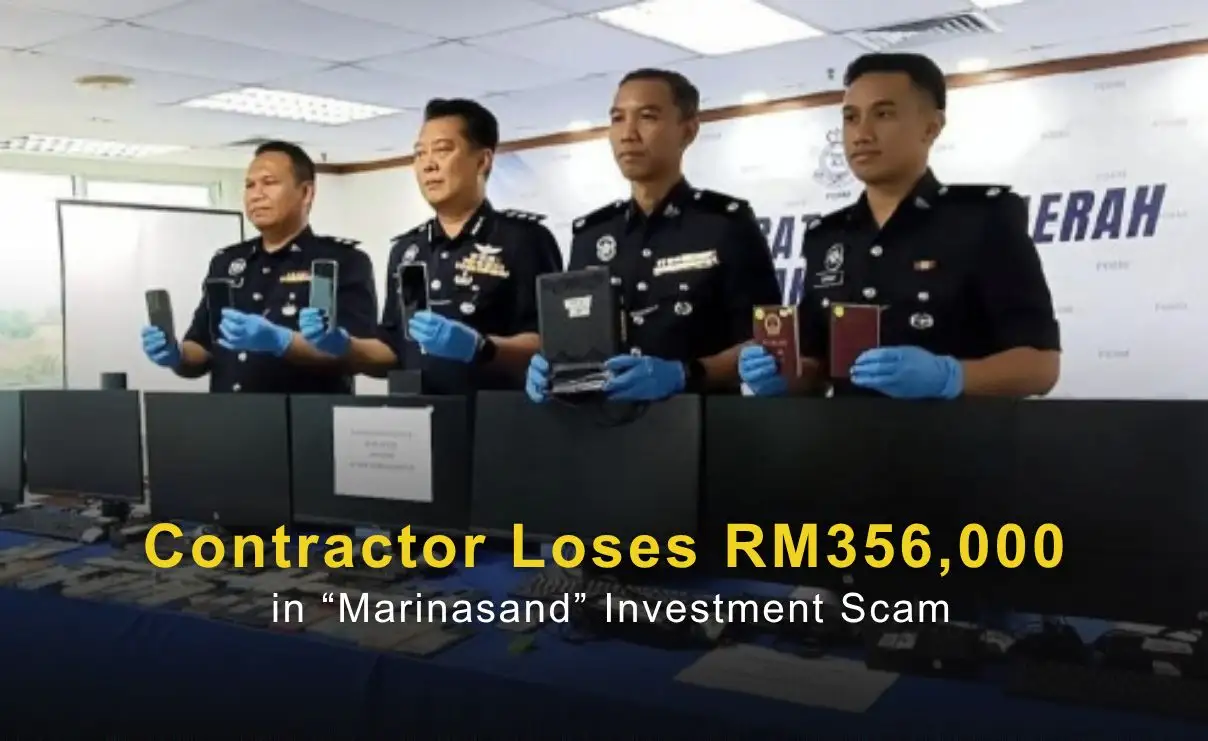
A contractor in Pahang has suffered a devastating financial loss of more than RM356,000 after becoming entangled in an online investment scam named “Marinasand”.
 WikiFXWikiFXWikiFXWikiFXWikiFXWikiFXWikiFXWikiFXWikiFXWikiFX
