
FCA-Regulated Forex Brokers Are Declining — 31 Platforms to Avoid
As of December 1, 2025, a total of 105 companies in the United Kingdom held CFD licences.
Original

简体中文
繁體中文
English
Pусский
日本語
ภาษาไทย
Tiếng Việt
Bahasa Indonesia
Español
हिन्दी
Filippiiniläinen
Français
Deutsch
Português
Türkçe
한국어
العربية

Abstract:President Marcos signs the Maharlika Investment Fund (MIF) into law despite controversy, aimed at job creation, economic growth, and poverty reduction in the Philippines.
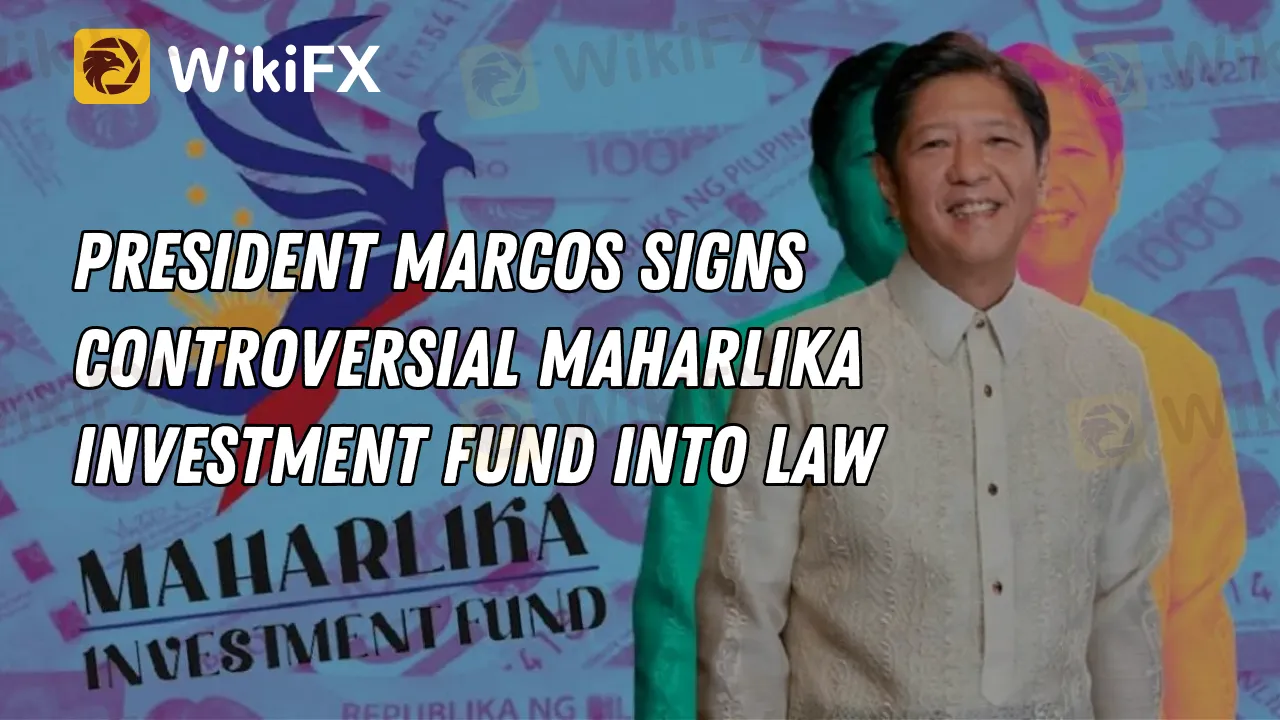
MANILA, Philippines - The country's president, Ferdinand “Bongbong” Marcos Jr., has officially given the nod to the much-debated Maharlika Investment Fund (MIF) bill. The signing of the bill, held in the historical Kalayaan Hall of the Malacañang Palace, has now transformed the MIF into a law. It took place amidst a mixture of support and criticism from the legislative members of both the Senate and the House of Representatives.
The Maharlika Investment Fund (MIF), a venture cloaked in controversy, has seen opposition from lawmakers due to potential investment risks. Aquilino Pimentel III, the Senate Minority Leader, had vociferously urged Marcos to veto the legislation. Pimentel's main concern revolved around the law diverting crucial resources away from immediate, pressing issues such as the education and healthcare sectors.
Echoing these sentiments, Senator Francis Escudero labeled the MIF as “a leap into the unknown”. This conveys the inherent uncertainty and potential drawbacks of the fund, which have elicited apprehension among some lawmakers.

Despite these voices of dissent, President Marcos deemed the bill as critical, expediting its passage through both chambers of Congress. This came as no surprise since the MIF received strong backing in both chambers. The Maharlika Investment Fund bill successfully secured 279 votes in the House of Representatives and an additional 19 votes in the Senate.
However, not all lawmakers sided with the majority. A total of seven lawmakers, including Sen. Risa Hontiveros and Representatives France Castro, Raoul Manuel, Arlene Brosas, Edcel Lagman, Mujiv Hataman, and Gabriel Bordado, voted against the MIF, raising their concerns over the potential risks and uncertainties associated with the fund.
Despite the criticism, proponents of the Maharlika Investment Fund maintain that it will bring a host of benefits to Filipinos. Senator Mark Villar, in his statement, outlined the various advantages that the MIF is expected to yield.

“Actually, there are a lot of benefits that we can get from the MIF. First, it would create more jobs, more infrastructure projects mean more job opportunities for Filipinos. Secondly, we will promote economic growth since better infrastructure leads to more efficient transportation, communication, and other systems. Also, this will be a vehicle to reduce poverty, this would help the government manage its budget and mitigate fiscal pressures during economic downturns as it acts as a safety net for the country,” Villar stated.
In essence, proponents see the Maharlika Investment Fund as a pathway to enhanced job creation, infrastructural development, and economic growth, alongside providing a financial buffer during economic slumps. Critics, however, remain wary of its potential pitfalls and diverting resources from other critical sectors.
It's clear that the Maharlika Investment Fund represents a bold move on the part of the government, one that has stirred both support and controversy. As the dust settles, the focus will be on how the MIF delivers on its promises and manages its potential pitfalls.
Stay updated on the latest developments about the Maharlika Investment Fund by downloading and installing the WikiFX App on your smartphone. Download the App here: https://www.wikifx.com/en/download.html.

Disclaimer:
The views in this article only represent the author's personal views, and do not constitute investment advice on this platform. This platform does not guarantee the accuracy, completeness and timeliness of the information in the article, and will not be liable for any loss caused by the use of or reliance on the information in the article.

As of December 1, 2025, a total of 105 companies in the United Kingdom held CFD licences.

With the rapid growth of the global multi-asset investment market, the disparities in the forex industry across different regions have become increasingly evident. As a forex broker information service platform operating in over 200 countries and regions, WikiFX is committed to helping investors in each region identify reliable brokers. Therefore, WikiFX launched a series content — Close Up with WikiFX, which offers in-depth interviews with local brokers. Leveraging WikiFXs robust big data system and industry insights, the series aims to help investors gain a deeper understanding of high-quality brokers. In this exclusive interview, we had the opportunity to speak with Konstantinos Theodorou, CEO of InterStellar Group-Cyprus, to explore the company’s operations and market insights.

BotBro is a Dubai-based forex broker that has continued to grab headlines for years, with its name being involved in one scam after another. In the latest episode, its name was found in the alleged INR 800 crore forex and crypto trading scam in Goa. Top-level agencies, including the Enforcement Directorate (ED), are investigating the case. They have labeled the platform as a Ponzi scheme. The platform is disguised as an AI-powered forex trading app. In connection with this case, the Goa Police Economic Offences Cell (EOC) filed a First Information Report (FIR) against 10 individuals, including the company owner, Lavish Chaudhary Alias Nawab Ali, for fund misappropriation worth over INR 7.3 crore. Read on as we share the BotBro review in this article.

In what would lift the mood of rupee derivative traders, the Reserve Bank of India (RBI) partially lifted some restrictions on rupee derivative trades imposed by the regulator on April 1, 2026. On this day, the central bank prevented banks from issuing non-deliverable forwards to clients and barred companies from reassessing forward contracts as part of its strategy to counter arbitrage trades, which caused fluctuations in the rupee’s exchange rate. The central bank further prevented banks from signing FX derivative contracts involving the rupee with their associated parties. Read on!
 WikiFXWikiFXWikiFXWikiFXWikiFXWikiFXWikiFXWikiFXWikiFXWikiFX
