CTBC Securities Review: Is This Taiwan Broker Safe for Forex?
Read our CTBC Securities review to learn about its regulation, login process, and Forex trading services. Find out if CTBC Securities is the right broker for you.
Original

简体中文
繁體中文
English
Pусский
日本語
ภาษาไทย
Tiếng Việt
Bahasa Indonesia
Español
हिन्दी
Filippiiniläinen
Français
Deutsch
Português
Türkçe
한국어
العربية

Abstract:Asian shares were down for a sixth straight session on Tuesday after a renewed spike in European energy prices stoked fears of recession and pushed bond yields higher, while tipping the euro to 20-year lows.
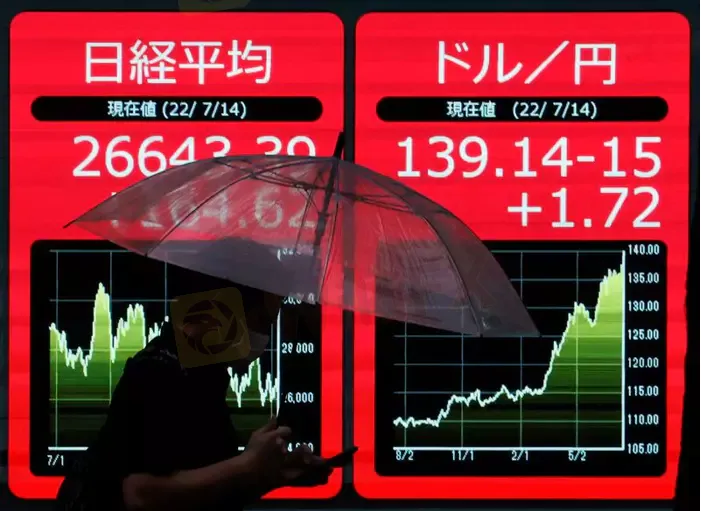
European stocks looked set to follow Asian equities. EUROSTOXX 50 futures and FTSE futures were both off around 0.2% after sliding overnight.
Benchmark gas prices in the European Union surged 13% overnight to a record peak, having doubled in just a month to be 14 times higher than the average of the past decade. [NG/EU]
Analysts at Citi warned inflation in Britain could top 18% if energy prices were not restrained.
European and British manufacturing surveys due later on Tuesday were expected to highlight the damage being done to activity, with Germany seen deeper in contractionary territory.
“Europes dire energy situation suggests the peak of inflation is not here yet and the risk remains that high inflation is sticky for longer without further aggressive central bank action,” said Tapas Strickland, a director of economics at National Australia Bank.
“No surprise then to see the dollar at near multi-decade highs against a falling euro and British pound.”
The single currency was struggling at $0.9929, having dropped 1% to a 20-year trough of $0.99265 on Monday.
The break of the July low at $0.9952 was taken as a bearish sign for a further push lower, with little in the way of chart support left.
Sterling was down at $1.1755, after diving as deep as $1.1743 and levels last seen in March 2020 at the start of the pandemic. That saw the dollar index up to 109.100 and within a whisker of its July peak.
In Asia, unease over Chinas economy continued to percolate as a cut in lending rates and talk of a fresh round of official loans to property developers underlined stresses in the sector.
“It would be bad enough for Chinese equities if the economys struggles were confined to the property sector,” said Oliver Allen a market economist at Capital Economics.
“But growth in the services sector seems unlikely to accelerate by much so long as Chinas zero-COVID policies remain in place; the pandemic-linked export boom is coming to an end; and power shortages due to droughts in parts of the country look set to hobble industry in the near term.”
Chinese blue chips were off 0.5% having received only a fleeting lift from the latest policy easing. Chinas yuan fell to an almost two-year low. [CNY/]
MSCIs broadest index of Asia-Pacific shares outside Japan dipped 0.9% to hit a one-month low, and has fallen every day in the past week.
The Nikkei lost 1.3% after a PMI survey showed factory activity in Japan slowed to a 19-month low in August amid persistent rises in raw material and energy costs.
S&P 500 futures and Nasdaq futures both edged 0.1% lower, following sharp falls on Monday when rising bond yields undermined tech shares. [.N]
The benchmark U.S. 10-year yield hit a five-week high of 3.040% on Monday, while the 30-year yield climbed to a seven-week peak of 3.268%.
Ten-year yields were last trading at 3.0109%, up almost 50 basis points from the lows of early August. [US/]
The move in part reflects hawkish commentary from Federal Reserve officials which has led the market to price in a 59% chance of a 75 basis-point hike to 3.0-3.25% in September, and a peak for rates around 3.75%.
The ascent of the dollar and yields has been a drag for gold, which was hovering at $1,736 an ounce after hitting a three-week low overnight. [GOL/]
After a whipsaw session overnight, oil prices were bouncing as Saudi Arabia warned that the OPEC+ producer alliance could cut output. [O/R]
Prices have been weighed by demand concerns and the chance of a nuclear deal that could return sanctioned Iranian oil to the market.
Brent was up 50 cents at $96.99, while U.S. crude rose 63 cents to $90.93 per barrel.

Disclaimer:
The views in this article only represent the author's personal views, and do not constitute investment advice on this platform. This platform does not guarantee the accuracy, completeness and timeliness of the information in the article, and will not be liable for any loss caused by the use of or reliance on the information in the article.

Read our CTBC Securities review to learn about its regulation, login process, and Forex trading services. Find out if CTBC Securities is the right broker for you.

Is QUOTEX safe? Our latest QUOTEX review reveals major withdrawal issues and lack of regulation. Check recent cases before your QUOTEX login or Forex trading.

Concerned about AssetsFX? Discover recent allegations of withdrawal issues and account manipulation. Protect your investments – read our AssetsFX review now!

Did you fail to execute the trade order on the Mazi Finance platform despite sufficient margin and adequate leverage? Did the broker breach the norms associated with profits gained through scalping? Failed to receive profits from the forex broker despite multiple attempts? Lured to invest under the impression of lucrative bonuses, but fell into the high spread trap? In this Mazi Finance review article, we have examined a series of alleged forex trading glitches by the trading enterprise. Let’s start investigating!
 WikiFXWikiFXWikiFXWikiFXWikiFXWikiFXWikiFXWikiFXWikiFXWikiFX
