Breaking: USD/JPY Breaks Through 1 Year Highs
USD/JPY just broke through 1-year highs earlier than expected.
Original

简体中文
繁體中文
English
Pусский
日本語
ภาษาไทย
Tiếng Việt
Bahasa Indonesia
Español
हिन्दी
Filippiiniläinen
Français
Deutsch
Português
Türkçe
한국어
العربية

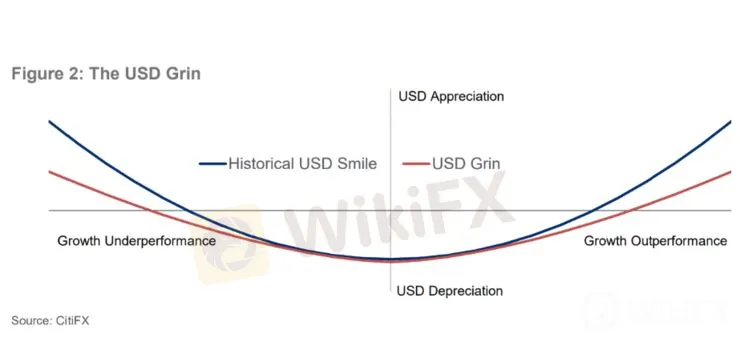
Abstract:DXY has slid as more as 10% since this March and the losses have deepened in recent weeks amid the second wave of the pandemic. The theoretical dollar smile has flattened, sending a painful “grin” to investors instead.
WikiFX News (8 Aug)- DXY has slid as more as 10% since this March and the losses have deepened in recent weeks amid the second wave of the pandemic. The theoretical dollar smile has flattened, sending a painful “grin” to investors instead.
Capital Ltd., the U.S. currency tends to increase in value against other currencies when the U.S. economy is weak. It goes up at either end of the spectrum, just like the smile on your face. Actually, after hitting the high in March, the greenback continuously slumped to a two-year low in July. In this regard, it should have poised for a rally in theory.
But the assumption he made turned out to be wrong. The dollar has languished as rising infections and mortality from the pandemic sapped appetite for the currency as a haven. The dollar smile has flattened and turned into a painful “grin”.
According to Boris Schlossberg, managing director of FX strategy at BK Asset Management, the dollar has suffered from a very serious decline during the whole month of July. Interest rates are going down, and that makes the dollar much less attractive, but the market is starting to become aware of the political risk of the dollar. He thus made a bold prediction that the dollar was heading for a crash and the world gold standard system would rise again.
All the above is provided by WikiFX, a platform world-renowned for foreign exchange information. For details, please download the WikiFX App: bit.ly/WIKIFX
You can also find us here-
Vietnam: www.facebook.com/wikifx.vn
Thailand: www.facebook.com/wikifx.th
Indonesia: www.facebook.com/wikifx.id
South Asia: www.facebook.com/wikifxglobal
Italy: www.facebook.com/wikifx.it
Japan: www.facebook.com/wikifx.jp
India: www.facebook.com/wikifx.in
Pakistan: www.facebook.com/wikifx.pk
Arabian countries: www.facebook.com/wikifx.arab
Russian countries: www.facebook.com/wikifx.russian
French countries: www.facebook.com/wikifx.French
Western Pacific area: www.facebook.com/wikifx.westernpacific
Disclaimer:
The views in this article only represent the author's personal views, and do not constitute investment advice on this platform. This platform does not guarantee the accuracy, completeness and timeliness of the information in the article, and will not be liable for any loss caused by the use of or reliance on the information in the article.

USD/JPY just broke through 1-year highs earlier than expected.
A Good Week For the US Dollar As It Gains Strongly Against Other Major Pairs.
Performance like this hasn't been seen since 2021

The EUR/USD pair ended the week in the red last week as many investors remained in a holiday mood. It was trading at 1.1720, down slightly from last year’s high of 1.1910 ahead of key events this week.
 WikiFXWikiFXWikiFXWikiFXWikiFXWikiFXWikiFXWikiFXWikiFXWikiFX
