Abstract:After all three of the major US stock indices went up yesterday, the market’s risk appetite was also reflected in currencies, including AUD and NZD.
WikiFX News (June 2th) - After all three of the major US stock indices went up yesterday, the markets risk appetite was also reflected in currencies: both Australian and New Zealand dollars surged yesterday, while the safe haven yen and US dollar dropped.
Fueled by central bank‘s stimulus and certain degrees of complacency, the stock market’s rally has been severely at odds with the fundamental situations, being termed as “surrealism” and “optimism” by some analysis.
This upbeat sentiment has spread from US to the Asia-Pacific stock market.
The Nikkei 225 index opened higher, which also boosted the risk-sensitive Australian and New Zealand dollars, while the US dollar and Japanese yen were flat overall.
In terms of the Asian session, investors should particularly pay attention to the Reserve Bank of Australias interest rate decision. The RBA is expected to hold the cash rate at 0.25% unchanged and keep 3-year government bond yield target at 0.25%. The policy announcement is expected to trigger fluctuation of the Aussie.
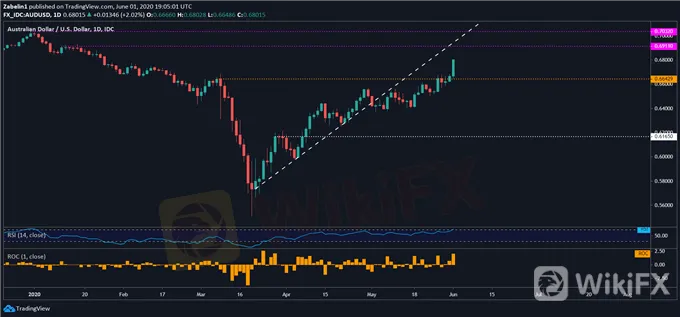
AUD/USD surged significantly after breaching above 0.6642, the previous resistance which has currently become a support level. The pair may again test the January high of 0.6911 and could even pass this level to challenge 0.7032, which is the highest in several months.
Disclaimer:
The views in this article only represent the author's personal views, and do not constitute investment advice on this platform. This platform does not guarantee the accuracy, completeness and timeliness of the information in the article, and will not be liable for any loss caused by the use of or reliance on the information in the article.