

Global Broker Regulation Inquiry App
About WikiFX
English
简体中文
繁體中文
English
Pусский
日本語
ภาษาไทย
Tiếng Việt
Bahasa Indonesia
Español
हिन्दी
Filippiiniläinen
Français
Deutsch
Português
Türkçe
한국어
العربية
Why High Leverage and Spread Widening Trigger Margin Calls
Abstract:Many new traders quickly lose their trading capital because they misunderstand how leverage and spread widening interact during volatile markets. This article breaks down the mechanics of a margin call and explains why market liquidity and order execution matter. The main takeaway is to calculate position sizes based on a fixed risk percentage and verify your broker's reliability.
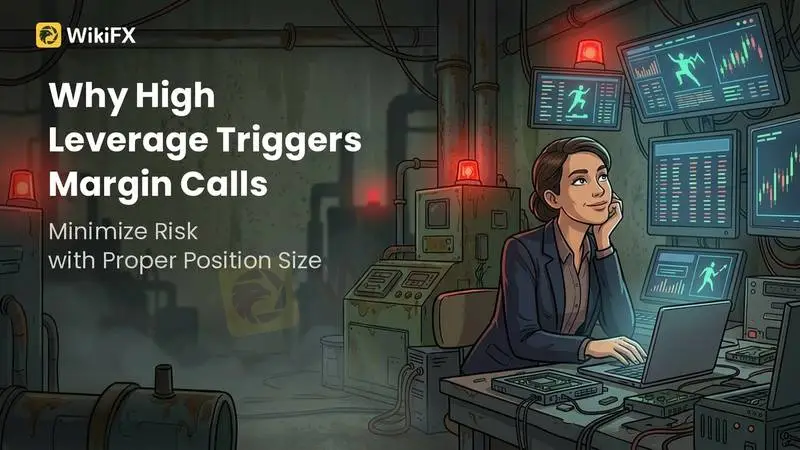
You fund your new trading account, enter a position on what looks like a clear trend, and sit back. Suddenly, price momentum drops, the numbers turn red, and your entire position is closed out by your broker.
Many beginners face this exact scenario. They are left wondering if the market is rigged or if their strategy was entirely wrong. Usually, it is neither. The culprit is typically a combination of using too much leverage and being caught in a sudden spread widening. Understanding how these mechanics work will save you from blowing up your account.
The Twenty-Five Pip Disaster
Forex brokers offer leverage so you can control a large position with a small deposit. While this sounds appealing, it dramatically reduces your room for error.
Let us look at a practical example. You open a mini account and deposit $10,000. The margin required to open one mini lot of EUR/USD is $100. If you buy 1 lot, you have $9,900 of “usable margin” left. This represents the financial cushion that absorbs any temporary losses if the market moves against you.
But what if you get overly confident? You decide to buy 80 mini lots of EUR/USD. Your total used margin becomes $8,000, leaving you with only $2,000 of usable margin.
Because each pip on a mini lot is worth $1, an 80-lot position means every single pip movement changes your equity by $80. If the market drops just 25 pips, you lose $2,000 ($80 x 25). Since your usable margin was exactly $2,000, your account triggers a margin call. Your broker will immediately start closing your positions at the current market price to protect their own funds.
Twenty-five pips is a normal daily fluctuation for EUR/USD. Without proper risk management, a tiny market sneeze can wipe out 20% of your account in seconds.
Why Do Spreads Suddenly Widen?
When you place a trade, you face two prices: the bid (selling price) and the ask (buying price). The difference between them is the spread, which acts as the cost of your transaction.
In quiet markets, the spread on a pair like EUR/USD might be tight, around 1 or 1.5 pips. However, many beginners try to trade during volatile times, such as the release of US non-farm payroll (NFP) data or speeches by central bank officials. During strong market activity, uncertainty rises. Liquidity providers—the large banks that supply pricing to your broker—widen the spread to protect themselves from rapid price swings.
Instead of a 1.5-pip spread, you might suddenly face a 5-pip or 8-pip spread.
Let us go back to the 80-lot margin call example. If the spread suddenly widens to 3 pips as soon as you enter the trade, the market only needs to move 22 pips against you to trigger the margin call, not 25. The wider the spread, the faster you hit your margin limit or stop-loss.
The Danger of Slippage and Low Liquidity
Beginners often rely heavily on stop-loss orders, assuming they provide absolute protection. But a stop-loss is simply a market order that activates when a specific price is reached. It relies entirely on market liquidity—the presence of willing buyers and sellers.
If a severe shock hits the market, such as the Swiss Franc “Black Swan” event in 2015, liquidity dries up entirely. When you want to sell your position to stop your losses, there may be nobody willing to buy it at your requested price. Your broker will execute your order at the next available price, which could be dozens or even hundreds of pips away. This is known as negative slippage.
For a trader utilizing maximum leverage, severe slippage means that the loss will far exceed the intended stop-loss amount, completely destroying the account balance.
Protecting Your Account
You cannot control the market's liquidity or its sudden movements, but you can control your exposure.
First, stop sizing your trades based on maximum available leverage. Use the fixed risk method. Professional educators suggest risking no more than 1% or 2% of your total account balance on a single trade. If you have $10,000, you should structure your lot size and stop-loss distance so that your maximum potential loss is only $100 to $200.
Second, avoid holding heavily leveraged positions over the weekend. Markets are closed to retail traders on Saturday and Sunday, but major global events can still happen. When the market reopens on Monday, the price can “gap” significantly from Friday's close, bypassing your stop-loss completely.
Finally, understand who handles your trades. If your broker operates as a dealing desk, they might take the other side of your trade. If they are an agency broker, they pass your orders to liquidity providers. Regardless of the model, you need a broker with the capital depth and technical stability to execute your orders fairly, even during fast markets. Before committing your funds, use WikiFX to check your brokers regulatory licenses and read up on their complaint history. Choosing a well-regulated platform is the baseline for ensuring your stop-losses are respected and your funds remain safe.

Disclaimer:
The views in this article only represent the author's personal views, and do not constitute investment advice on this platform. This platform does not guarantee the accuracy, completeness and timeliness of the information in the article, and will not be liable for any loss caused by the use of or reliance on the information in the article.
WikiFX Broker
Latest News
D Prime Review: Regulation, Licences and WikiScore Analysis
 WikiFX
naqdi Review 2026: Is this Forex Broker Legit or a Scam?
WikiFXDollar Drops Against Major Currency Pairs
WikiFXPhysical Crude Disconnects From Futures Markets
WikiFXTradeEU Review 2026: Is this Forex Broker Legit or a Scam?
WikiFXVatee Review: Regulation, Licences and WikiScore Analysis
WikiFXBroker Minimum Deposits and the Reality of Account Setup
WikiFXT4Trade Regulation Review 2026: Is This Broker Safe or a Scam?
WikiFXIs Trader's Way Regulated? The 2026 Truth About its Licenses and Corporate Warnings
WikiFXSpread Co Review 2026: Rating, License, Complaints, and Risk Signals
WikiFXCurrency Calculator
USD

CNY
Current Rate:0
Enter amount
USD
Redeemable Amount
CNY
Calculate 