

Global Broker Regulation Inquiry App
About WikiFX
English
简体中文
繁體中文
English
Pусский
日本語
ภาษาไทย
Tiếng Việt
Bahasa Indonesia
Español
हिन्दी
Filippiiniläinen
Français
Deutsch
Português
Türkçe
한국어
العربية
STMARKET Regulation: A Complete Guide to Their Licenses & Company Registration
Abstract:This guide will examine all available information to give you a clear and honest assessment of the risks involved. We will look at the company structure, study the details of the STMARKET Regulation , STMARKET License, and compare what the broker claims online with what can actually be verified. Our goal is not to make trading decisions for you, but to provide the facts you need to protect your money. Understanding a broker's real legal and regulatory status is the most important step when checking if they are trustworthy.
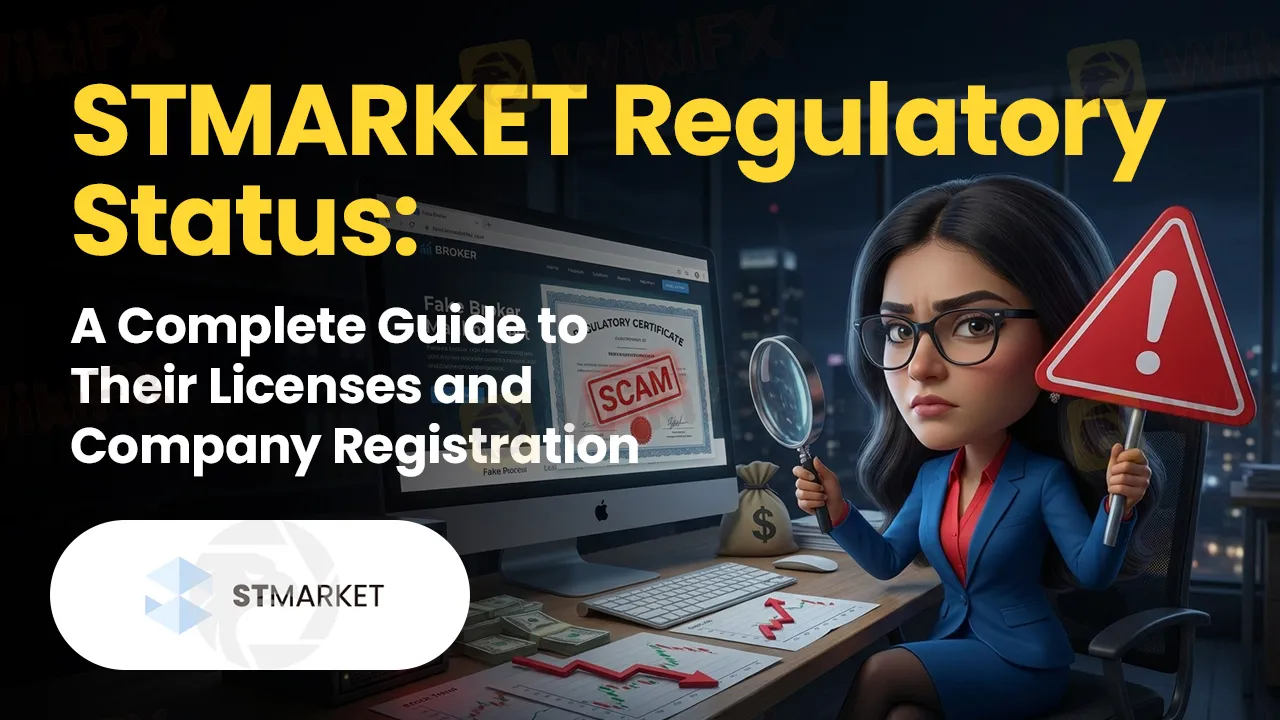
Traders researching STMARKET Regulation often find confusing and contradictory information. The broker appears to be a UK-based company with a UK phone number and registered business. However, their actual office address and regulatory license are located in Cambodia. This mismatch between how they present themselves and reality is a major warning sign that needs careful investigation.
This guide will examine all available information to give you a clear and honest assessment of the risks involved. We will look at the company structure, study the details of the STMARKET Regulation , STMARKET License, and compare what the broker claims online with what can actually be verified. Our goal is not to make trading decisions for you, but to provide the facts you need to protect your money. Understanding a broker's real legal and regulatory status is the most important step when checking if they are trustworthy.
Choosing a broker involves more than just looking at trading costs and platforms; it's about making sure they are legitimate. Conflicting information is a major red flag. Before you think about opening an account with any broker, especially one with a complicated profile like STMARKET, you should use an independent verification tool. We strongly recommend checking the broker's complete profile and current status on a platform like https://www.wikifx.com/en/dealer/7121233630.html to get an unbiased view.
Breaking Down The Company Structure
A detailed look into STMARKET Regulation shows not one, but two separate companies operating under a similar brand name. This two-company structure is common in the forex industry, but it often serves to hide the true operational and legal framework of the broker. Understanding what these two companies do is key to assessing the real risks.
The Registered Companies
The two companies connected to the STMARKET brand are registered in two very different places: the United Kingdom and Cambodia. Their details show major contrasts and highlight the main problem with how the broker presents itself.
| Feature | ST MARKET UK LTD | STMARKET COMPANY LIMITED |
| Region | United Kingdom | Cambodia |
| Registration No. | 12576898 | 00049975 |
| Status | Active | Active |
It is important to note the details of the UK company. While a director was appointed in April 2020, public records show an official establishment date of September 1, 2024. This kind of mismatch in company filings adds another layer of confusion and potential concern for investors seeking clarity and transparency.
The UK-Cambodia Problem
This two-company structure is a major red flag for several reasons. The main issue is the misleading impression it creates. Many traders see a UK-registered company and assume STMARKET Regulation, level of safety and oversight associated with the United Kingdom.
Importantly, having a registered company in the UK, such as ST MARKET UK LTD, does not mean the broker is regulated by the UK's Financial Conduct Authority (FCA). The FCA is a world-renowned, top-level regulator with strict rules on client fund protection, negative balance protection, and a strong compensation scheme (the FSCS). STMARKET holds no such license.
The company that clients actually make agreements with, STMARKET COMPANY LIMITED, is based in Cambodia. This means that all client funds, trades, and legal agreements fall under Cambodian law, which offers much weaker investor protection standards. The UK company appears to serve mainly as a marketing tool, using the UK's strong financial reputation to attract clients who are then signed up by the offshore, Cambodian-regulated company. This practice is often called using a “shell company,” and its purpose is to create a false sense of security.
Examining The STMARKET License
A broker's regulatory license is the single most important document for a trader to verify. It determines the rules the broker must follow, the protections given to clients, and the legal options available if there is a dispute. While IS STMARKET Regulation technically a regulated broker? The quality and location of that regulation are extremely important.
The Official License Details
A review of regulatory records confirms the following facts about the STMARKET Regulation:
• Regulator: Securities and Exchange Regulator of Cambodia (SERC)
• Licensed Entity: STMARKET COMPANY LIMITED
• License Type: Derivatives Trading License (EP)
• License Number: 00049975
These details confirm that the broker's operations are governed by the Cambodian financial authorities, not any UK or European body.
Quality of SERC Regulation
From a global perspective, the Securities and Exchange Regulator of Cambodia (SERC) is considered an offshore regulator. Brokers think getting STMARKET Regulation from any authority is better than being completely unregulated, offshore licenses provide much lower levels of investor protection compared to top-tier jurisdictions.
In practice, this means:
• Lower Capital Requirements: Offshore regulators typically require brokers to hold far less operational capital, making them more vulnerable to financial problems.
• Lack of Fund Separation Rules: Top-tier regulators like the UK's FCA and Australia's ASIC have strict rules requiring brokers to keep client funds in separate accounts, away from the company's operational funds. This protects client money if the broker fails. Such rules are often weak or non-existent in offshore jurisdictions.
• No Compensation Schemes: Traders with FCA-regulated brokers are protected by the Financial Services Compensation Scheme (FSCS), which can compensate clients up to £85,000 if a firm fails. There is no equivalent safety net for clients of a SERC-regulated broker.
• Less Strict Oversight: Enforcement, reporting standards, and day-to-day supervision are generally less rigorous compared to established financial centers.
Why This Matters
The difference between a top-tier and an offshore license directly affects the safety of your funds. Trading with a broker regulated only in Cambodia, like STMARKET, is categorized by independent analysis as carrying a “High potential risk.”
Should you encounter a problem, such as a withdrawal issue, a trade dispute, or even the broker's complete failure, your legal options are extremely limited. Pursuing a claim through the Cambodian legal system would be difficult, expensive, and likely unsuccessful for an international client. The regulatory framework simply lacks the strong protective measures that traders in well-regulated regions take for granted.
A broker's license is their most important credential. A weak license can be as dangerous as no license at all. Verifying the STMARKET Regulation . You can use platforms like https://www.wikifx.com/en/dealer/7121233630.html to not only see if a license is active but also to understand the strength and protection level of the regulating body.
Real-World Facts vs. Online Claims
A broker's website and marketing materials are designed to build trust. However, these claims must be checked against real-world facts. In the case of STMARKET Regulation, there is a stark and concerning difference between its online image and its verifiable physical presence.
The UK Phone, Cambodian Address
The broker's contact information is a prime example of this conflicting messaging. STMARKET prominently displays a UK toll-free number: `+44 (0) 800 368 9785`. This immediately suggests a UK-based customer support team and a substantial presence in the country.
However, the official physical address listed for the company is on the 23rd floor of the AMASS Tower in Phnom Penh, Cambodia. This combination is a classic tactic used by offshore brokers. The UK phone number is often a simple VoIP (Voice over Internet Protocol) service that can be routed anywhere in the world. It is inexpensive to set up and serves to create an illusion of being based in a reputable financial hub, while the actual operations are conducted from a jurisdiction with lower costs and weaker regulation.
“No Physical Presence” Verification
The most compelling piece of evidence against the STMARKET Regulation implied UK presence comes from independent, on-the-ground investigation. Field surveys conducted to verify the addresses associated with ST MARKET UK LTD have consistently returned the same result: “No Physical Presence Found.”
This finding is critical. A genuine broker with operations in a country will have a real, staffed office—a place for compliance officers, support staff, and management. A physical office is a sign of a real operational investment and a point of accountability. In contrast, a “virtual office” or a simple company registration address with no actual staff on-site holds no substance. It is merely a mailing address.
The confirmed lack of a physical UK office, when combined with the offshore STMARKET License, paints a clear picture. It strongly suggests that the UK connection is a front, designed to mislead potential clients about the broker's true nature and the level of risk they are undertaking.
Conclusion: A Final Assessment of Safety
After a thorough analysis of STMARKET Regulation , company structure, regulatory licensing, and physical presence, we can combine the findings to deliver a clear assessment of its safety as a brokerage for traders. The evidence points overwhelmingly toward a high-risk environment masked by a misleading marketing strategy.
Summary of Warning Signs
The investigation has uncovered several critical risks that any potential client must consider:
• Weak, Offshore Regulation: The broker's only license is from Cambodia's SERC. This provides minimal investor protection, with no financial compensation scheme and weak enforcement compared to top-tier regulators.
• Misleading UK Presence: STMARKET uses a UK-registered company and a UK phone number to project an image of safety and legitimacy. However, this company is not FCA-regulated and has no verified physical office, indicating it is a “shell” company.
• Conflicting Information: The combination of a UK phone number with a Cambodian address and regulation is a classic red flag designed to confuse traders about where the broker is truly based and regulated.
• Clear Risk Warnings: Independent analysis tools assign STMARKET a very low score, explicitly warning of “High potential risk” and advising traders to stay away due to these significant concerns.
Your Final Takeaway
While STMARKET technically holds a STMARKET License, the quality of that license and the multitude of surrounding red flags make it an exceptionally high-risk choice for any trader. The operational structure appears deliberately designed to attract clients using the reputation of the UK while binding them to the legal and regulatory framework of a much weaker jurisdiction. The formal warnings from independent evaluators—“Warning: Low score, please stay away!”—should be taken with the utmost seriousness.
Your money is on the line. The evidence regarding STMARKET Regulation points to significant risks that should not be ignored. We strongly urge all traders to prioritize their financial security. Before engaging with any broker, make it a mandatory habit to conduct your own comprehensive check. Utilize a trusted, independent resource like https://www.wikifx.com/en/dealer/7121233630.html to examine regulatory details, review field surveys, and read user feedback. A few minutes of verification can protect you from months of distress and potential financial loss.
Disclaimer:
The views in this article only represent the author's personal views, and do not constitute investment advice on this platform. This platform does not guarantee the accuracy, completeness and timeliness of the information in the article, and will not be liable for any loss caused by the use of or reliance on the information in the article.
WikiFX Broker
Latest News
Najm Capital Review 2026: UAE-Facing Broker, but the Licence Picture Raises Questions
 WikiFX
Pocket Trade Review: Withdrawal Denial, Profit Deletions & Customer Support Complaints
WikiFXOil Surges As Dollar Climbs
WikiFXWarren Bowie & Smith Broker Review: A High-Risk Trap for Forex Traders
WikiFXRetiree Loses RM900,000 After Falling for Sophisticated YouTube Investment Scam
WikiFXShe Lost RM281,700 via 8 Transfers After Trusting WhatsApp ‘Investment Adviser’
WikiFXCrude Advances On Strait Friction
WikiFXHow Interest Rates and the US Dollar Control Currency Prices
WikiFXRM300 Million Investment Scandal: Prominent ‘Tan Sri’ to Face Charges in Malaysia
WikiFXXTRADE Review 2025: Is This Forex Broker Safe?
WikiFXCurrency Calculator
USD

CNY
Current Rate:0
Enter amount
USD
Redeemable Amount
CNY
Calculate 