Abstract:Deriv stands as a colossal figure in the retail trading landscape, recognized for its extensive global footprint and a multi-jurisdictional regulatory framework that spans from Europe to Southeast Asia. With a WikiFX score of 7.04, the broker commands significant influence, particularly in regions like the UAE, Australia, and parts of South America. Established in its current form in 2019, Deriv markets itself as a flexible, tech-forward broker offering access to diverse markets via the MetaTrader 5 (MT5) ecosystem. However, recent data suggests a growing dichotomy between its high-level regulatory status and the ground-level friction reported by traders, particularly regarding capital accessibility and sudden policy shifts.
Deriv stands as a colossal figure in the retail trading landscape, recognized for its extensive global footprint and a multi-jurisdictional regulatory framework that spans from Europe to Southeast Asia. With a WikiFX score of 7.04, the broker commands significant influence, particularly in regions like the UAE, Australia, and parts of South America. Established in its current form in 2019, Deriv markets itself as a flexible, tech-forward broker offering access to diverse markets via the MetaTrader 5 (MT5) ecosystem. However, recent data suggests a growing dichotomy between its high-level regulatory status and the ground-level friction reported by traders, particularly regarding capital accessibility and sudden policy shifts.
Regulation & Safety Assessment
Deriv operates under a complex web of licenses, utilizing different entities to service clients depending on their geographical location. For traders asking “Is Deriv safe?”, the answer depends largely on which specific entity holds their account. The broker maintains a mix of strong, tier-1 regulation and more flexible offshore oversight.
Public regulatory records confirm the following license structures:
Safety analysis reveals a split profile. While the oversight from Malta (MFSA) and Malaysia (LFSA) provides a layer of institutional security, a significant portion of the retail business is funneled through offshore entities in the BVI and Vanuatu. Of note is the status of its Cayman Islands (CIMA) license, which is currently flagged as “Exceeded,” indicating operations may be stretching beyond the authorized scope of that specific license.
Furthermore, regulatory disclosures show friction in Southeast Asia. The Indonesian regulatory body, BAPPEBTI, has included Deriv's domains in blocklists for operating without local authorization, highlighting the risks pertinent to traders operating in jurisdictions where the broker lacks specific local licensure.
Trading Environment & Platform Experience
The core of Deriv's offering is the MetaTrader 5 (MT5) platform. Data indicates the software setup is robust, supporting a highly customizable trading environment with multilingual support and clear fee reporting. The platform is well-regarded for its search functionality and execution speeds under normal conditions.
However, the technology aspect is not without its gaps. The current security infrastructure lacks two-factor authentication (2FA) or biometric logins for the platform interface, a standard feature now expected for modern financial apps.
In terms of funding, Deriv offers one of the most exhaustive lists of payment rails in the industry. Traders can move funds via standard bank transfers and credit cards (VISA, Mastercard), as well as a massive array of cryptocurrencies (Bitcoin, Ethereum, Tether TRC20/ERC20) and e-wallets like Skrill, Neteller, Boleto, and Pix. While this accessibility is a strength on paper, the ease of deposit contrasts sharply with the withdrawal experiences reported by some users.
Deposits, Withdrawals & User Experience
Despite the high WikiFX score, the user feedback loop is dominated by a surge of serious complaints. In the last three months alone, over 50 complaints have been logged, revealing systemic issues regarding fund retention and trade execution.
Withdrawal Roadblocks and KYC Loops
A persistent theme involves the freezing of accounts during the withdrawal process. Multiple traders have reported that after profitable trading periods, their requests to withdraw funds trigger endless verification loops.
One case from Nigeria in November 2025 described a scenario where a trader's transfer was blocked despite verifying their ID weeks prior. Similarly, an Indonesian user reported their account—holding substantial capital—was frozen for “suspected unusual trading.” This user claimed they were asked to provide six months of bank statements and even pay a “fund verification fee,” a practice highly irregular for regulated brokers.
Sudden Leverage Reductions
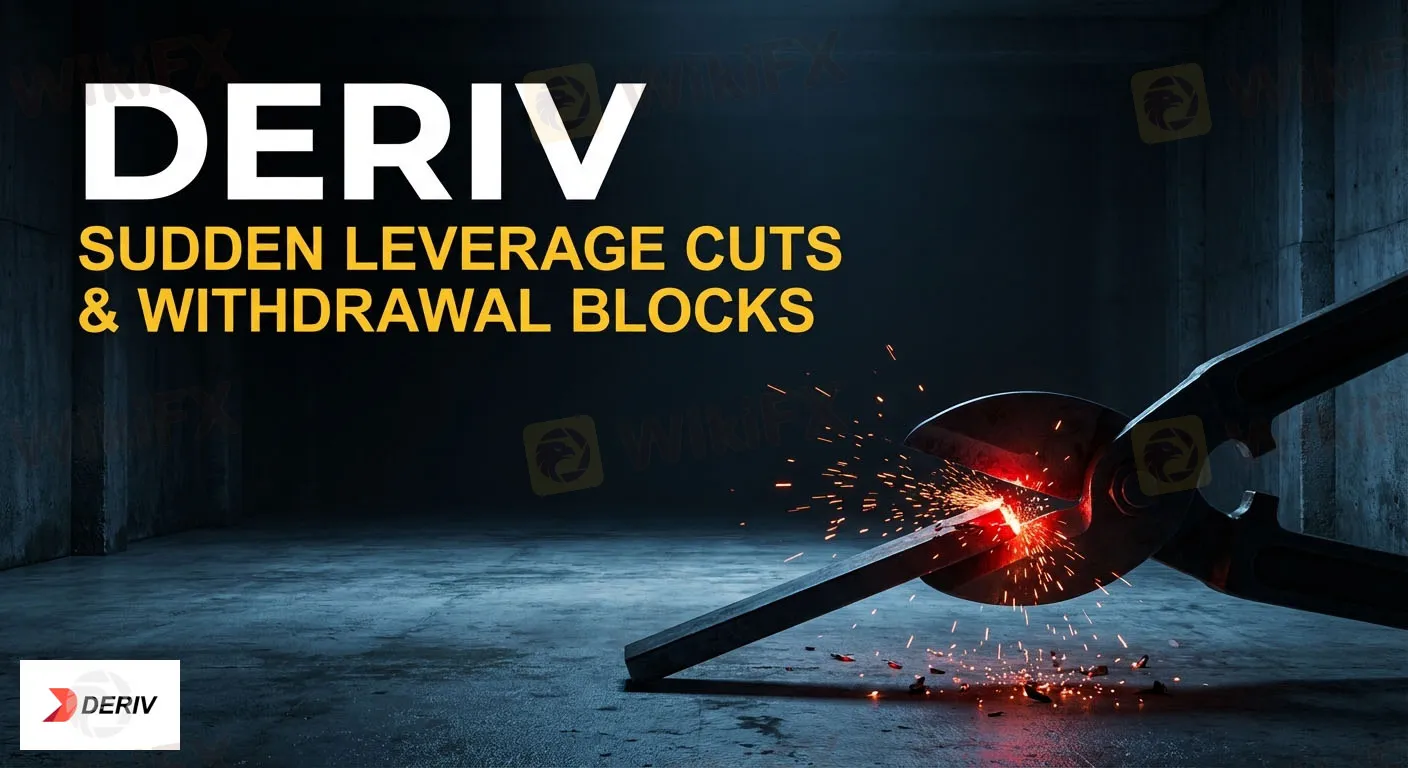
Execution stability appears to be another volatility point. Several traders reported that Deriv unilaterally lowered leverage ratios on open positions, leading to immediate margin calls and forced liquidation.
In one instance involving an Indian trader, the leverage on a USD/INR position was reportedly cut from 1:200 to 1:50 overnight. This aggressive risk adjustment caused the trade to liquidate, wiping out the trader's capital before they could react or top up the margin. This contradicts the stability professional traders confuse with “safety.”
Slippage and “Price Jumps”
Complaints also detail anomalies in price feeds. A trader dealing in binary-style contracts noted that prices would “jump” 0.2 to 0.5 pips in the opposite direction of the trade during the final five seconds of a contract associated with high slippage not correlated with market news. Another user reported that a refund was only processed after 13 months, and only after they escalated the matter to multiple regulators including the LFSA and MFSA.
Strengths & Weaknesses
Strengths
- Regulatory Breadth: Holds licenses in Malta, UAE, and Labuan, providing credible oversight for specific jurisdictions.
- Platform Standard: Full support for MT5 with deep customization options.
- Payment Flexibility: Accepts a vast range of cryptocurrencies and local payment methods globally.
Weaknesses
- Complaint Volume: A high density of recent grievances (51 in 3 months) related to withdrawals and account freezes.
- Operational Risk: Reports of sudden leverage changes and aggressive internal risk management harming client positions.
- Offshore Reliance: Heavy reliance on BVI and Vanuatu entities for retail accounts, which offer lower investor protection than European counterparts.
- Regulatory Flags: “Exceeded” status in Cayman and website blocks in Indonesia.
Final Outlook for Traders
Deriv presents a complicated proposition. On one hand, its 7.04 score and Tier-1 licenses in Malta and the UAE suggest a legitimate, established financial institution. It is not a fly-by-night operation; it is a major global brokerage with deep infrastructure.
however, the operational reality for many profitable traders tells a cautionary tale. The pattern of complaints suggests that Deriv applies strict, sometimes opaque, risk management policies that can result in frozen assets or sudden leverage reductions. For global traders, particularly those in unregulated jurisdictions relying on offshore entities, this poses a tangible risk.
Is Deriv safe? From a regulatory perspective, it is legitimate. However, purely based on user experience trends in late 2025, traders should approach with caution. It may be suitable for low-leverage, casual trading, but high-volume or highly profitable traders should remain vigilant regarding withdrawal terms and potential execution slippage.
Risk Warning
Forex and CFD trading involve significant risk to your invested capital. Leverage can work against you as well as for you. Please ensure you fully understand the risks involved and do not invest money you cannot afford to lose.